
Summit County Parole and Probation
Parole is conditional release from a Utah prison sentence. The Utah Board of Pardons and Parole may set a parole date, keep a case under review, rescind an earlier date, or later terminate the sentence. Probation is usually ordered by a court. It can start without any state-prison term, including after a county case resolves. Utah Department of Corrections Adult Probation and Parole, known as AP&P, supervises both groups when the order places the person in the state system.
A Summit County Jail release is therefore only one event. Someone may finish the jail portion, post bond, or receive probation and then report to a supervision officer. A person leaving prison on parole remains under the sentence. Complete discharge comes later, when the Board terminates supervision or the maximum term expires. The live jail list cannot settle that question because it reports who is housed now, not who is serving a sentence in the community.
| Point | Parole | Probation |
|---|---|---|
| Starting authority | Utah Board action after imprisonment | Court sentence or order |
| Custody meaning | Prison confinement ended under conditions | May begin without state imprisonment |
| Main state supervisor | UDC Adult Probation and Parole | UDC AP&P when assigned to state supervision |
| Best public trail | UDC record plus latest Board decision | UDC record plus sentencing court docket |
| Final end | Board termination or maximum expiration | Court or supervising authority discharge |
- Parole
- Conditional release from imprisonment while the sentence continues.
- Probation
- Court-ordered community supervision that may replace or follow a jail term.
- Discharge
- The formal end of supervision or the sentence, not merely release from a building.
- Absconder
- A supervised person alleged to have stopped reporting or left supervision without approval.
Check Summit County Post-Release Supervision
The most reliable check uses more than one record. UDC warns that its offender search covers people currently under its supervision. It can include a state prisoner, parolee, and some probation cases, but it is not a permanent archive of every discharged person. A Summit County pretrial detainee who never entered UDC jurisdiction may not appear at all.
- Search UDC by full first and last name, adding the middle name when helpful. Use the offender number if known because similar names can collide.
- Open the detail and record the exact Location, Housing Facility, Release Date/Type, Case Manager, and Case Manager Email fields. Do not call a facility label community release without reading its value.
- For parole, search the Board portal by name or offender number. Read the latest decision and look for a later rescission, violation, warrant, reinstatement, or termination entry.
- For probation, check the sentencing court docket. Summit Justice Court handles Class B and C misdemeanors; district court supplies the felony trail.
- Contact the responsible office if the public records disagree. Ask only for releasable status or routing information and expect limits on private supervision details.
The UDC AP&P page confirms the agency’s role and Region 3 coverage. The screenshot below shows the official state source used to route a Summit supervision check.
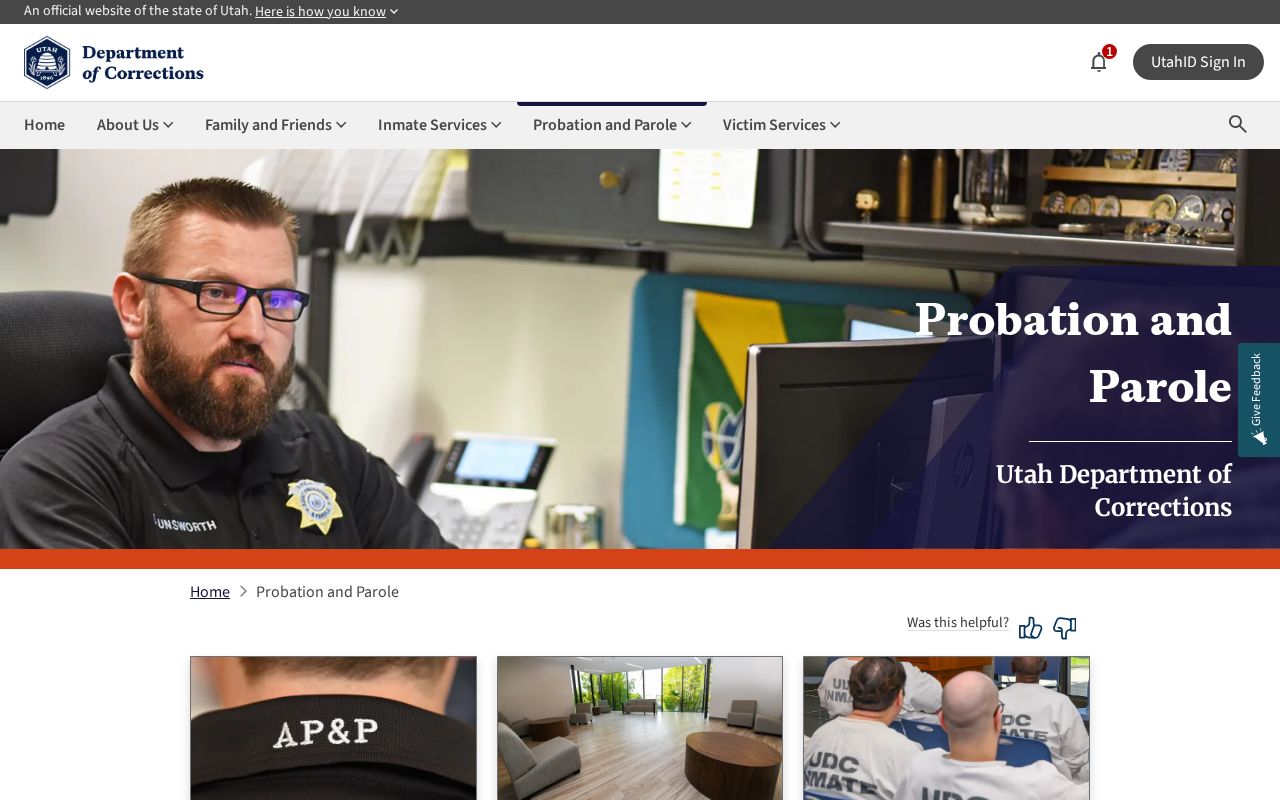
That state page is the proper starting point for AP&P responsibilities, while the individual record and issuing authority establish a particular person’s status.
Important: A future hearing, favorable Board decision, or old release date does not prove current community status. Check for later action and present placement.
Summit County AP&P Region 3
Summit County does not have a separate state AP&P region office. UDC assigns Summit with Salt Lake and Tooele counties to Region 3 in Salt Lake City. This office handles state parole and probation routing. It is distinct from the county Probation and Drug Court contact listed by the Sheriff Administrative Division, which addresses local court supervision. Calling the county contact for a state parole case, or the state office for a purely local case, can lead to delay.
UDC Adult Probation and Parole, Region 336 W. Fremont Avenue
Salt Lake City, UT 84101
801-239-2100
UDC AP&P may confirm where a case should be routed, but public access does not guarantee a home address, visit schedule, full case plan, treatment detail, or every condition. Use the case manager shown in the UDC detail only for a proper status question. A court clerk can explain a public docket, though the clerk cannot replace the supervising agency’s current information.
For an older Summit County case that no longer appears in the UDC public search, use the latest Board decision, the court record, or a focused UDC records request. The Summit County released-inmate search and records path explains how a county release record differs from a state supervision record.
Note: Record the date, office, and answer from any telephone check because an oral response may not serve as written proof later.
Summit County AP&P Holds
Summit County’s posting-bail instructions draw a sharp line between a bondable charge and an AP&P hold. Cash, card, or cashier’s check may resolve a new bondable charge when permitted. A “No Bail,” AP&P, or judge hold cannot be cleared by payment or surety. The county says release requires a judge’s order.
This local rule matters when verifying release. Payment on one charge may be valid, yet another hold can keep the person in custody. Ask the jail whether all holds cleared and whether the outcome was community release or transfer. A state supervision record, court order, and jail custody entry can each describe a different part of the same event. None should be stretched beyond its role.
An AP&P hold also should not be read as a new conviction. It signals that state supervision authority may need review. The later Board or court action may restore supervision, order further custody, set a new date, or resolve the allegation in another way.
Summit County Warrants and Absconders
AP&P may seek a warrant if a person stops reporting or otherwise leaves supervision without approval. That is an alleged absconder status, not a discharge and not proof that the person is free from all custody. The Board portal may later show a warrant, violation hearing, recalled warrant, reinstatement, new parole date, rescission, or sentence termination. Read the newest entry rather than treating a single result as final.
Summit County Justice Court adds a local timing concern. Its warrant information warns that status can change daily or hourly. Someone booked on a warrant may stay in jail until bail is posted or the next available court date. The county says that process can take up to ten days. A static warrant list cannot calculate an exact release date.
Conditions also vary by order. AP&P describes reporting, residence checks, assessment or treatment, travel and curfew limits, restitution or fines, community service, and case planning as common areas. A public summary should not be assumed to reveal every condition. Confirm the current legal status with the issuing body.
Note: “Absconder” describes an alleged supervision problem; it never means the sentence or supervision term ended.
Summit County Release and Reentry
The Summit County Jail connects treatment, education, vocational instruction, life skills, and work programming with community integration. UDC’s county-jail program book also identifies AA/NA, St. Mary’s, mental-health sessions, and inmate work assignments at the facility. Those are real local program details, but participation never proves that an individual was released or that supervision ended.
After release, AP&P case planning may address the requirements in the person’s order. The controlling document remains the court or Board action. A program completion can affect state case planning or earned-time review, yet it is not an automatic discharge certificate. Verify the record before assigning a legal effect to participation.
Release from a Summit jail bed can also be a transfer. UDC contract prisoners may leave the county building while staying in state custody. For those cases, follow UDC Location and Housing Facility values and the Board decision instead of treating roster removal as community reentry.
Summit County Supervision Discharge
Physical release and final discharge are separate milestones. A parolee has left prison but remains under the sentence. A probationer may have left jail yet remain subject to the court order. The supervision record ends only through the applicable Board or court action, or when the governing maximum term expires. Utah Code §76-3-202 is especially relevant to parole duration, while the Board’s latest case decision shows whether it terminated a particular sentence.
Final status can matter long after the jail event. Utah’s petition-based expungement timing generally runs from the latest of case completion, release from jail or prison, or termination of probation or parole. That makes the actual discharge date different from, and sometimes later than, the date a person walked out of custody. Use the current Utah Courts process for any individual eligibility question.
A no-result needs careful handling. UDC limits its public search to people under present supervision, so disappearance may follow complete discharge rather than prove that no state case existed. The Board portal and sentencing docket can preserve the ordered outcome after the live supervision entry is gone. Ask UDC for a releasable discharge record when those sources do not resolve the date.
For a clear record trail, retain the UDC detail, latest Board or court decision, and any formal discharge document. VINELink can provide a custody-change alert, but it is not a certified supervision archive. When public sources conflict, ask the agency that issued or administered the order.