
Summit County Scheduled and Actual Release
A scheduled date is a plan based on the information and legal authority available at that point. Actual release is the completed event recorded when custody ends or changes. The two are not interchangeable. Summit County’s current jail PDF publishes neither a projected nor an actual release date. It shows only Name, Booking #, Location, Time Incarcerated, and total housed. A name disappearing from that snapshot does not supply the missing timestamp.
For state cases, UDC uses the exact public label “Release Date/Type.” It does not label the field “Projected Release Date.” A future entry can be a strong lead, but UDC does not promise that the combined field is a fixed projection. Board review, pending matters, sentence structure, conduct, earned-time application, and a later rescission can change the result. Read the value with current Location and Housing Facility data.
Scheduled versus actual: A future date, hearing date, or release order is not proof that a person physically left custody. Confirm the completed event with the jail, UDC, or receiving agency.
A pretrial detainee has no sentence-based date to calculate. Bond can permit departure, but an AP&P, “No Bail,” judge, immigration, federal, or other agency hold may prevent it. A county-sentenced person may have a calculation, though Summit County publishes no official local good-time formula or weekend policy. Ask the jail for the computation and the court for the controlling order.
Lookup a Summit County Release Date
Start with custody class, not a general name search. The Summit County Jail, UDC, Board, and court systems answer different questions. A local booking does not appear in the UDC search merely because the arrest occurred in Utah. Conversely, a UDC contract prisoner housed at the county jail remains a state prisoner and follows the state release path.
- Check Summit County’s current inmate-list landing page. If the person appears, call jail main at 435-615-3723 and ask whether a date is set, which holds apply, and which office maintains the calculation.
- Check the sentencing court. Summit Justice Court handles Class B and C misdemeanors, while felony matters require Utah district-court records. Look for the signed order, sentence, bond, warrant, or later modification.
- For a state prisoner or supervised person, search UDC by full name or offender number. Open More Information/View and read Location, Housing Facility, Release Date/Type, and case-manager fields together.
- Search the Board portal for the newest decision. Distinguish a tentative hearing month, scheduled hearing, parole date, review, violation, and rescission.
- Confirm close to the expected date. Ask whether the event was community release, transfer, continued supervision, or another custody change.
The official UDC offender-search page displays the scope warning and state search route shown below.
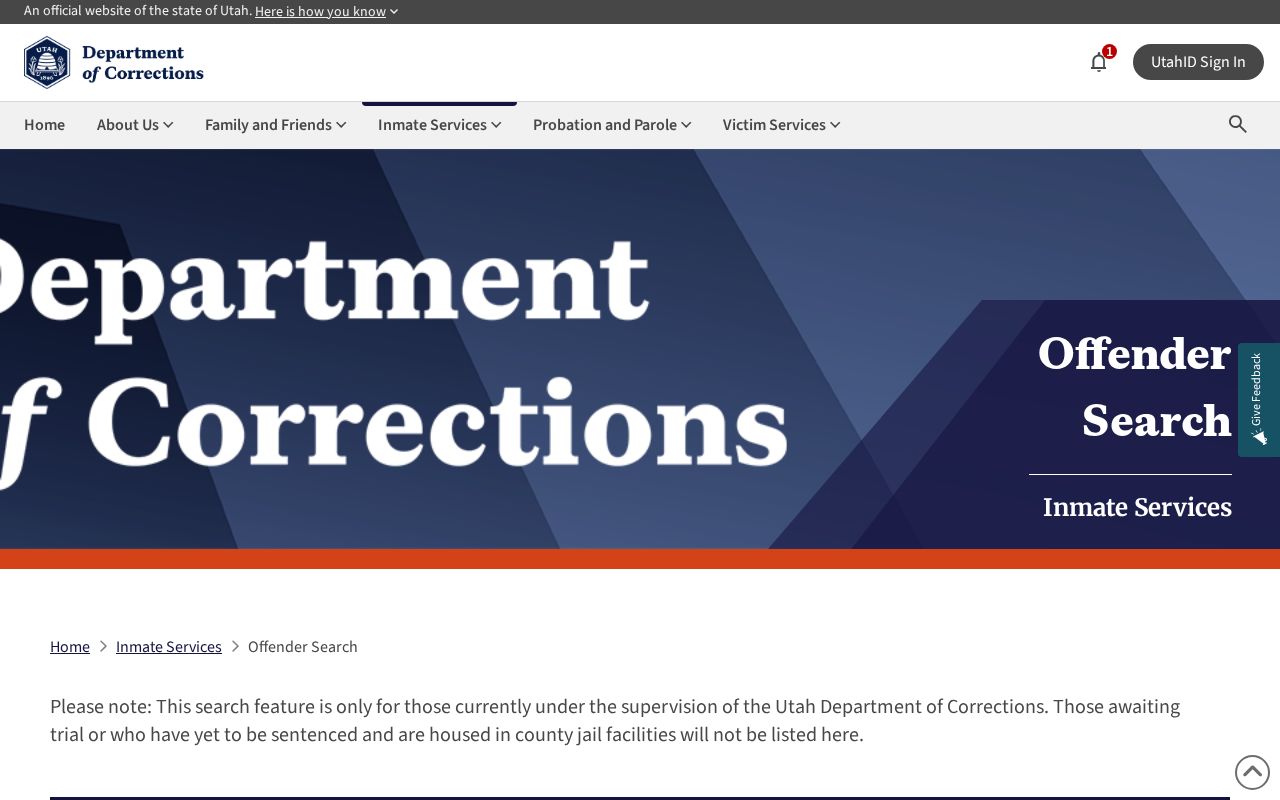
That warning explains why a Summit County pretrial detainee may be absent and why a fully discharged former prisoner may no longer appear.
Note: Use an offender number when available because it reduces errors caused by common names, spelling variants, and aliases.
Summit County State Release-Date Fields
UDC name search requires First Name and Last Name and offers Middle Name. An offender number is the alternate route. Results list Offender Number, Offender Name, Date of Birth, and More Information/View. The detail adds the fields needed to interpret a release date. Copy each value as shown rather than replacing state labels with a guessed meaning.
| UDC field | How it helps | Limit |
|---|---|---|
| Location | Shows the state system’s current placement description | Must be read with Housing Facility |
| Housing Facility | Helps distinguish a prison or other placement | A facility name alone does not prove release |
| Release Date/Type | Provides the exact state date-and-type label | May change and is not separately called projected |
| Case Manager | Identifies a state contact tied to the record | Disclosure and appropriate-use limits apply |
| Case Manager Email | Provides a routing channel when displayed | Not a substitute for a Board decision |
UDC says the public tool covers people currently under its supervision. A parolee may still appear because imprisonment ended while supervision continues. Complete discharge may remove the result. If a formerly supervised person has no result, search the latest Board decision and court docket or make a focused UDC records request.
Utah’s Board portal accepts first, middle, and last names, an offender number, or a date range. A hearing result proves that review was scheduled. It does not prove release. Decisions may set a parole date, order review, continue confinement, rescind a date, address a violation, reinstate supervision, or terminate the sentence.
Utah Rules for Summit Release Dates
Utah generally uses indeterminate prison sentences. The court imposes a statutory range, and the Board decides release within that range. The Utah Sentencing Commission discusses common ranges such as zero-to-five, one-to-fifteen, and five-to-life, but a guideline is a starting point rather than a guaranteed release date. Without earlier Board action, the maximum controls.
There is no generic rule that every Utah prisoner serves 85 percent. That rule belongs to other sentencing systems and should not be applied to a Summit County case. Utah Code §77-27-9 supplies minimum and release restrictions for specified circumstances and also governs rescission authority. The current statute and the person’s exact sentence structure control.
The Board considers more than elapsed time. Its materials identify sentence structure, offense facts, court and UDC reports, risk, victim material, past supervision, institutional conduct, case-action-plan work, programming, and the release plan. No one item forces an outcome. A tentative hearing month is based on available guideline and case information, while exact scheduling begins only a few weeks before that month and can move if reports, charges, or capacity issues change.
- Tentative hearing date
- An estimate for Board review, not a day of release.
- Parole date
- A date ordered by the Board that can still be changed before release.
- Maximum expiration
- The sentence endpoint if no earlier lawful termination applies.
- Detainer
- A request or hold from another authority that can change where the person goes next.
Summit County Earned-Time Release Credit
Utah Code §77-27-5.4 requires a Board earned-time program for successful completion of qualifying recidivism-reduction programs. UDC describes mandatory reductions of four months for each of up to two approved case-action-plan programs, ordinarily a maximum of eight months. Only the first of two vocational programs receives mandatory treatment. A later vocational completion may be presented for discretionary review.
This is not a daily Summit County jail good-time formula. It concerns eligible state prisoners and qualifying program completion. Transition needs can reduce the amount actually applied when too little time remains for required services. Life-without-parole cases and other statutory limits also remain controlling. Administrative Rule R671-311-3 addresses adjustments, and a person without a current release date is not eligible for an adjustment, though completion may be considered later.
The UDC earned-time explanation is captured below and should be checked with the current law for a specific case.
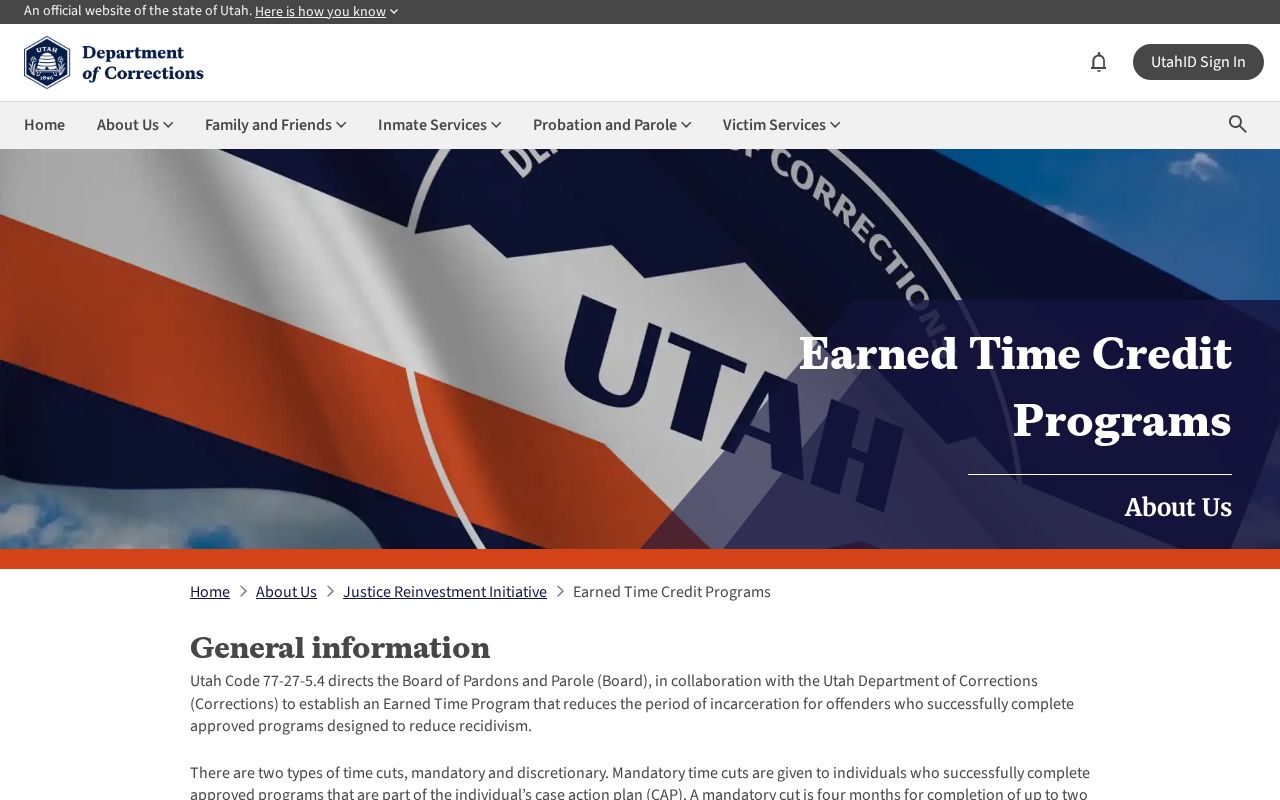
The state program can adjust an existing Board date, but completion alone does not set a release day or prove that custody ended.
Why Summit County Release Dates Change
A date can move before the person leaves custody. The agency with legal control must update the record, and older screenshots may preserve a value that no longer applies. Compare the newest Board action, present UDC placement, current court order, and any known hold.
| Factor | Possible effect | Where to verify |
|---|---|---|
| Board rescission or review | Removes or changes an earlier parole date | Latest Board decision |
| Qualifying earned time | May reduce an existing state date | UDC and Board record |
| New conduct or conviction | May prompt recalculation or further review | Board, UDC, and court |
| AP&P or judge hold | Can prevent release despite payment on another charge | Jail and issuing authority |
| Transfer or detainer | Changes destination rather than freeing the person | Sending and receiving agencies |
| Missing case material | Can move a tentative Board hearing | Board portal or office |
For county warrant bookings, Summit’s court says a person may wait for the next available court date, potentially up to ten days, unless bail allows earlier release. Because warrants can change daily or hourly, that outer description is not a personal calculator. Call the court and jail.
Note: A transfer closes one facility stay but does not establish release to the community.
Summit County Release-Date Records
County verification is available through several distinct channels. Jail main at 435-615-3723 can give a current status lead and identify which office holds the calculation. The Justice Court at 435-615-3800 can clarify its public docket and warrant process, but it cannot certify the minute a person crossed the jail door. For written proof, request the booking/release or custody-history entry through Summit County NextRequest and ask for the release timestamp, disposition, and destination if maintained and public.
Use a narrow date span and the booking number when possible. A written request under GRAMA may result in production, a denial with legal grounds, a statement that the county lacks the record, or notice of an extraordinary circumstance. The ordinary response framework in §63G-2-204 is not the same thing as a guaranteed release date. It governs access to an existing record.
Summit State-Prison Tuesday Releases
UDC’s release-day instructions add a distinctive logistics rule for state prisoners. State releases are processed on Tuesdays. Almost all UDC prisoners held in contract county jails first return to the Utah State Correctional Facility, and direct community release from a county jail is extremely rare. A Summit County roster removal for a contract prisoner may therefore mark transport within UDC rather than freedom.
Completed state releases generally move through the Utah State Correctional Facility Visiting building. UDC transports people assigned to community correctional centers. Those without rides may be taken to nearby UTA TRAX and handled late in the day’s release sequence. These facts apply to UDC prisoners, not ordinary Summit County detainees.
Close to the expected day, check UDC and the latest Board decision, then confirm the actual event. The VINE Inmate Check can add a release or movement notice where covered, but it cannot turn a transfer alert into community release proof.
Utah VINE can distinguish several state events. Its UDC list includes a parole-release-date alert before the expected event, release from prison, movement to a county jail, movement between prison sites, and transfer to a community correctional center. Those labels should remain exact. An advance alert is not completion, and a movement notice means custody changed location.
Family transport plans should therefore wait for direct confirmation. UDC says people in county contract beds are generally moved back into the state release process, and the expected time can shift within the release sequence. Ordinary Summit detainees follow county and court procedures instead. Mixing these systems produces a plausible date with the wrong releasing authority.